Skip to content
CodeMorph
v0.1.0 betaNow available for Windows

Migrate JavaScript to TypeScript. Verified.

CodeMorph is the AI code editor that converts your codebase file by file, leaf modules first, and proves every file still compiles and passes your tests.

Download for Windows

The CodeMorph film: from scan to a running app.

Free during the beta · Windows 10 and 11 · macOS and Linux waitlist open

A complete editor

Everything you expect from your editor. Plus a migration engine.

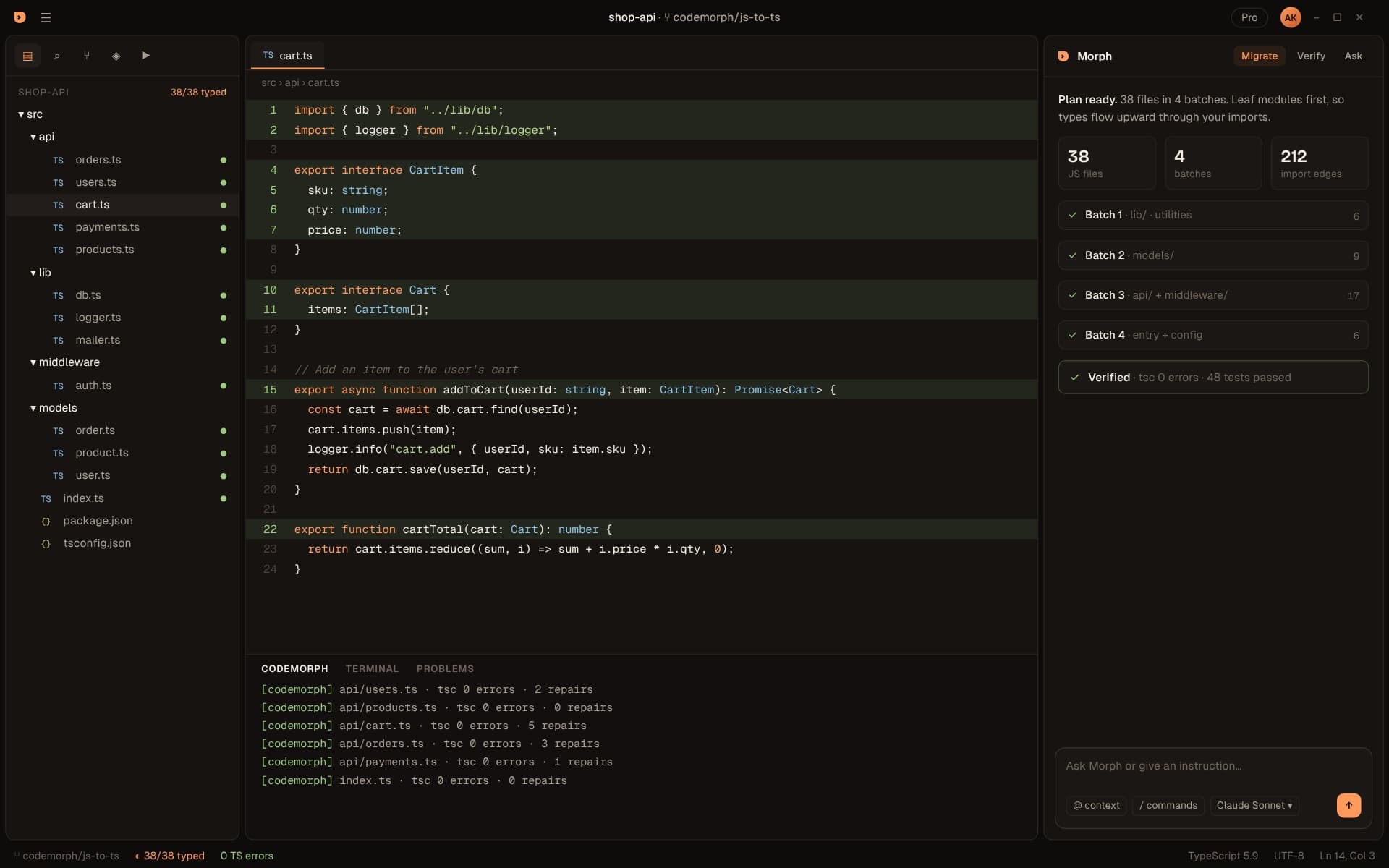
CodeMorph is a full desktop editor with the keybindings, layout and extensions developers already know. The difference is Morph: a migration engine and agent that understands how your files depend on each other.

Capabilities

01Scan & Plan

See the whole migration before a single file changes.

CodeMorph parses every file, resolves every import and builds a dependency graph of your project. Then it orders the work: leaf modules first, so types flow upward through your imports.

  • ESM and CommonJS parsed with tree-sitter, including re-exports and dynamic imports
  • tsconfig and jsconfig path aliases, barrels and index files resolved
  • Circular imports grouped so they migrate together
02Batch migration

Converted in batches, each one typed against the last.

Each batch is converted against imports that are already TypeScript, so the model infers real types from real call sites instead of guessing. The explorer shows progress file by file.

  • Grey, orange, green: every file's state in the explorer
  • Live log of each file, its tsc result and any repairs
  • Stop, resume or re-run any batch
03Diff review

Every change lands as a diff you approve.

Nothing is written behind your back. Review each file side by side, accept or reject it, and ask Morph to explain any type it chose before you commit.

  • Side-by-side JavaScript to TypeScript diffs
  • Accept per file or per batch
  • Works on a branch, so your history stays clean
04Run & Verify

Not just compiled. Proven.

After every batch CodeMorph runs tsc and your own test suite. Errors go back into a repair loop with the compiler output attached, and a batch is only marked verified when both pass.

  • tsc --noEmit against your real tsconfig
  • Your Jest or Vitest suite, run as-is
  • Verified means zero type errors and green tests
05Morph agent

Ask why. Get call sites, not guesses.

Morph lives in the side panel with your dependency graph as context. Ask why a type was chosen, tighten an any, or request a change, and it answers with the files and lines that justify it.

  • Answers grounded in the graph and real call sites
  • Bring your own Anthropic key, or run local models with Ollama
  • Opens with Ctrl+L, like the editor you already use

End to end

How a migration runs

Seven steps from an open folder to verified TypeScript. Each one produces something you can inspect before the next begins.

  1. 01

    Open your project

    Ctrl+L opens Morph
    Open the folder that contains package.json and trust the workspace. The Morph panel opens on the right with Migrate, Verify and Ask tabs.
  2. 02

    Scan

    seconds, fully local
    Every .js, .jsx, .mjs, .cjs, .ts and .tsx file is parsed with tree-sitter. Each import is resolved and classified as a local file, a package, a Node built-in, an asset or unresolved.
  3. 03

    Plan

    leaf-first batches
    Files are ordered with Tarjan's algorithm so dependencies always come first, circular groups stay together, and the work is packed into batches named by folder.
  4. 04

    Measure the baseline

    tsc --checkJs
    CodeMorph counts the type errors your JavaScript already has, so progress is measured against reality rather than a guess.
  5. 05

    Convert batch by batch

    your Anthropic key
    Each file is converted with its already-typed dependencies in context. Compiler errors go back into a bounded repair loop with the exact diagnostics attached.
  6. 06

    Review every file

    Accept or Reject
    Each file arrives as a side-by-side diff with a short summary of what was inferred and why. Nothing lands until you accept it.
  7. 07

    Verify

    typecheck, tests, build
    Run & Verify checks the whole project with tsc, your test script and your build script. When all three pass, you'll see Migration verified.

Before and after

Real types, from real usage

CodeMorph types each file against modules that are already TypeScript, so shapes come from the code itself instead of guesses. Logic stays exactly the same.

Before · orders.js
// src/api/orders.js
const { db } = require("../lib/db");
const { money } = require("../utils/money");

async function placeOrder(userId, cart) {
  const total = cart.items.reduce((sum, i) => sum + i.price * i.qty, 0);
  const order = await db.orders.create({ userId, total, items: cart.items });
  return { ...order, display: money(total) };
}

module.exports = { placeOrder };
After · orders.ts
// src/api/orders.ts
import { db } from "../lib/db";
import { money } from "../utils/money";
import type { Cart } from "../models/cart";
import type { Order } from "../models/order";

export interface PlacedOrder extends Order {
  display: string;
}

export async function placeOrder(userId: string, cart: Cart): Promise<PlacedOrder> {
  const total = cart.items.reduce((sum, i) => sum + i.price * i.qty, 0);
  const order = await db.orders.create({ userId, total, items: cart.items });
  return { ...order, display: money(total) };
}

Why leaf-first

Types flow upward. So does the migration.

Migrating a file before its dependencies forces the model to guess at shapes it can't see. CodeMorph converts files in topological order, so every file is typed against imports that are already TypeScript and already verified.

Leaf-first migration orderTwelve files in four batches. Batch 1 holds leaf modules in lib and utils, batch 2 the models that import them, batch 3 the API routes and middleware, and batch 4 the entry point. Each batch turns orange while it converts and green once verified.Batch 1 · leavesBatch 2Batch 3Batch 4 · entrylib/db.jslib/db.tslib/logger.jslib/logger.tslib/mailer.jslib/mailer.tsutils/money.jsutils/money.tsmodels/user.jsmodels/user.tsmodels/product.jsmodels/product.tsmodels/order.jsmodels/order.tsmiddleware/auth.jsmiddleware/auth.tsapi/users.jsapi/users.tsapi/cart.jsapi/cart.tsapi/orders.jsapi/orders.tsindex.jsindex.ts
JavaScript, not yet migrated Converting TypeScript, verifiedIllustrative project. Scan & Plan computes this order for your code today.

Compared with the usual approaches

Why migrations stall, and how CodeMorph is different

Every approach can produce TypeScript. The difference is whether you can trust the result without re-reading every line.

CapabilityBy handRename and suppressAI chat, file by fileCodeMorph
Converts in dependency order
Keeps circular imports together
Types inferred from real call sitesBy handPartly
Type-checks the whole project after each stepBy hand
Runs your tests and buildBy hand
Every change reviewed as a diffCopy and paste
Avoids blanket any and ts-ignoreSometimes
Code stays on your machine
Weeks of engineer timeYesLessLessLeast

"Rename and suppress" means renaming files to .ts and silencing errors with any or ts-ignore, by hand or with a codemod.

Who it's for

Built for the codebases that never got typed

Teams with a legacy Node API

An Express or Fastify backend that grew for years without types. CodeMorph types the data layer first, then models, then routes, and proves the API still passes its tests.

React and Next.js apps

JSX components become TSX with props inferred from how each component is actually rendered across the app, leaf components first.

Library maintainers

Ship real type definitions generated from typed source instead of hand-written .d.ts files that drift from the code.

Agencies inheriting codebases

Map an unfamiliar project in seconds: what depends on what, where the cycles are, which imports don't resolve, before you touch anything.

Teams adopting strict mode

Already on TypeScript but loose? Ask Morph for strict mode and migrate file by file to that bar with every step verified.

Engineering leaders

Turn a migration nobody owns into a plan with batches, progress and a definition of done the whole team can see.

Works with your stack

The JavaScript you actually ship.

Front end, back end and tests. If it's JavaScript or JSX, CodeMorph can graph it.

  • React
  • Node.js
  • Express
  • Next.js
  • Vite
  • Jest
  • Vitest
  • ESM and CommonJS, JSX, path aliases

Your code stays yours

Private by architecture, not by policy.

Local-first

Scanning, graph building and planning run entirely on your machine. The graph is a local SQLite file.

Bring your own key

AI features use your own Anthropic key, stored in the OS keychain. Or point Morph at Ollama and stay offline.

No telemetry

Telemetry and crash reporting are off by default in the build itself. Nothing phones home.

Open ecosystem

Thousands of extensions install in one click from Open VSX, the open extension registry.

How CodeMorph handles your code

Frequently asked questions

What exactly does CodeMorph do?
It's a desktop code editor with a migration engine built in. It maps how every file in your JavaScript project depends on every other file, converts files to TypeScript in that order, shows every change as a diff for you to accept, and runs your typecheck, tests and build to prove the result works.
Will it change my code without asking?
No. Scanning only reads files. Every converted file arrives as a diff that you accept or reject, and the migration works on its own branch.
How does CodeMorph know the migration worked?
Run & Verify runs tsc --noEmit across the whole project, then your test script, then your build script. A migration is verified only when all three pass.
Does my code get uploaded anywhere?
Scanning, planning, review and verification run locally. Conversion and Ask requests go directly from your machine to the model provider you configure, under your own account. CodeMorph has no server that receives your code.
Which AI model does it use?
Claude models from Anthropic, using your own API key. You pick the model in the Morph panel. Support for local models through Ollama is coming.
What kinds of projects work?
JavaScript and JSX projects with a package.json: React, Next.js, Vite, Node and Express apps, libraries, and test suites in Jest or Vitest. ES modules, CommonJS and mixed JavaScript and TypeScript projects are all supported.
How long does a migration take?
Scan & Plan takes seconds on most projects. Conversion time depends on project size and your model, and you review as you go, batch by batch, instead of facing one giant diff at the end.
What does it cost?
Nothing during the beta. Paid plans arrive at launch, the editor and Scan & Plan stay free, and model usage is always billed by your own provider.
Which platforms are supported?
Windows 10 and 11 (x64) today. macOS and Linux builds are planned; you can join the waitlist on the download page.

Your codebase, typed. And proven.

Download the beta, open a project and see your migration plan in under a minute.